An air quality consultant assesses pollution, prepares environmental reports, predicts emission impacts and recommends mitigation measures to support planning and environmental compliance.
Air quality is a key factor to think about when planning homes, offices, factories, and building projects. Poor air quality can harm people’s health, damage the environment, and influence planning decisions. So, air quality assessments are often required by local planning authorities for development projects across the UK.
An air quality consultant in the UK helps developers, architects, businesses and planning professionals identify potential pollution impacts. Their work includes assessing existing air quality, carrying out dispersion modelling, preparing technical reports and recommending suitable mitigation measures.
A skilled professional in air quality can help with project planning, checking dust risks during construction, monitoring air quality at workspaces, and supporting compliance with environmental requirements.
In this blog, we explore the role of an air quality consultant, the services they provide and when professional air quality consultancy may be required.
What Is an Air Quality Consultant?
An air quality consultant is an environmental specialist who assesses air pollution levels and evaluates how different activities or developments may affect the surrounding environment.
They work with developers, architects, local authorities, construction companies and industrial organisations to identify potential air quality issues and recommend suitable solutions.
An air quality consultant may assess pollutants such as:
Nitrogen dioxide (NO2)
Particulate matter (PM10 and PM2.5)
Nitrogen oxides (NOx)
Ammonia (NH3)
Other pollutants associated with industrial and combustion sources
These assessments help determine whether if a new development might affect the current air quality or expose people to higher levels of air pollution.
Air quality consultants refer to UK planning policy, environmental legislation and industry guidance, such as that published by the Institute of Air Quality Management (IAQM) and Defra, when preparing their technical reports.
What Does an Air Quality Consultant Do?
The responsibilities of an air quality consultant vary depending on the type, location and scale of the project.
Some projects need a simple screening assessment, while others require more detailed studies such as dispersion modelling, construction dust assessments or specialist environmental reports.
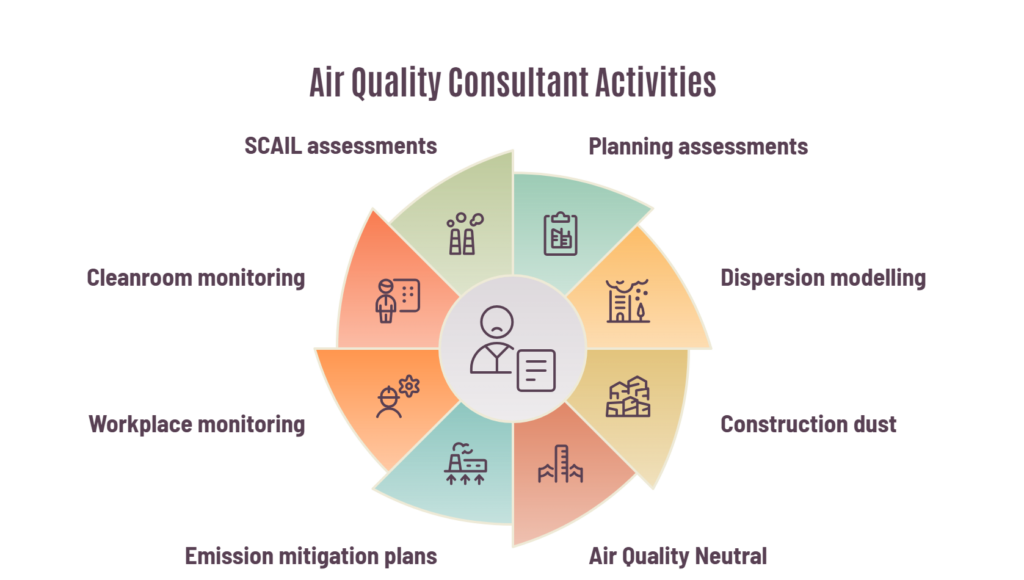
Here are some of the main activities carried out by an air quality consultant.
1. Air Quality Assessment for Planning Applications
One of the key responsibilities of an air quality consultant is to create air quality reports for use in planning applications.
A planned development could lead to increased traffic, emissions from heating and energy systems or other sources of air pollution . It might also introduce new people, such as residents, workers or visitors, into an area where air pollution is already a problem.
An air quality assessment evaluates these potential impacts and helps determine whether suitable measures are required.
A typical air quality assessment may include:
Reviewing existing air quality conditions.
Collecting local authority monitoring data.
Checking Defra background pollution maps.
Identifying nearby pollution sources.
Assessing existing and future pollutant concentrations.
Undertaking dispersion modelling where required.
Recommending suitable mitigation measures.
The assessment findings are presented in a technical report that can accompany a planning application.
2. Air Quality Dispersion Modelling
Air quality dispersion modelling is used to predict how pollutants released from different sources may spread through the surrounding environment.
It helps consultants estimate pollutant concentrations at nearby homes, schools, workplaces and other sensitive locations.
Dispersion modelling may consider:
Road traffic emissions.
Industrial emissions.
Boiler and energy plant emissions.
Development-related traffic.
Local meteorological conditions.
Building layouts and surrounding structures.
Depending on the project, specialist modelling software such as ADMS can be used to assess the potential impact of emissions.
The modelling results help determine whether predicted pollutant concentrations meet relevant air quality objectives and whether additional mitigation is necessary.
3. Construction Dust Risk Assessment
Construction and demolition activities can generate dust that may affect nearby residents, businesses and ecological receptors.
An air quality consultant carries out a Construction Dust Risk Assessment to evaluate potential dust impacts during different project stages.
These stages generally include:
Demolition activities.
Earthworks and site preparation.
Construction activities.
Trackout, where dust and dirt are carried from the site onto nearby roads.
The assessment follows current IAQM guidance and considers the potential magnitude of dust emissions, the sensitivity of nearby receptors and the effectiveness of proposed control measures.
Consultants may also use GIS to produce receptor maps showing sensitive locations near the development site.
Depending on the results of the assessment, it might be suggested to use a Construction Dust Management Plan or other appropriate mitigation may be recommended to reduce dust emissions from the site.
4. Air Quality Neutral Assessments
For relevant developments in Greater London, Air Quality Neutral assessments are an important part of the planning process.
Policy SI 1 of the London Plan requires development proposals to be at least Air Quality Neutral, and the Greater London Authority’s Air Quality Neutral London Plan Guidance (February 2023) sets out the benchmarks and method for assessing this.
The assessment compares the calculated emissions against the applicable Air Quality Neutral benchmarks.
Where necessary, an air quality consultant can recommend measures to reduce emissions and help the development meet the relevant planning requirements.
5. Emission Mitigation Plans
An emission mitigation plan outlines steps that can help lower air pollution caused by construction or operating activities.
These plans may be needed if a project could adversely affect local air quality or increase pollution in the area.
Depending on the project, mitigation measures may include:
Using cleaner construction equipment.
Reducing unnecessary vehicle movements.
Implementing dust suppression measures.
Improving site management practices.
Considering low-emission heating systems.
Providing suitable ventilation and filtration.
Reducing emissions from transport and energy use.
An air quality consultant works with the project team to identify practical measures based on the assessment results and relevant planning requirements.
6. Workplace Air Quality Monitoring
Air quality is important to consider in workplaces, especially in places like industrial plants, factories, laboratories, and other areas where workers may be exposed to harmful substances in the air.
Depending on the workplace, monitoring may include:
Inhalable and respirable dust.
PM10 and PM2.5.
Carbon dioxide (CO2).
Volatile organic compounds (VOCs).
Other relevant workplace contaminants.
Monitoring results can be reviewed against applicable Health and Safety Executive (HSE) Workplace Exposure Limits (WELs), set out in EH40/2005 , where relevant.
This information helps businesses identify potential exposure concerns and consider suitable control measures.
7. Cleanroom Monitoring and ISO 14644 Compliance
Cleanrooms are used in industries like pharmaceuticals, medical devices, healthcare, aerospace, and microelectronics.
These environments require tightly controlled conditions to keep airborne particle levels within defined limits.
Cleanroom monitoring can involve counting airborne particles, confirming that the room remains within its classification limits, and selecting suitable sampling locations.
ISO 14644-1 provides the framework for classifying cleanroom air cleanliness by particle concentration. ISO 14644-2 covers the monitoring needed to show that this performance is maintained.
An air quality specialist can help businesses develop a suitable cleanroom monitoring plan based on the facility’s classification requirements and operational needs.
8. SCAIL Assessments for Agriculture and Industry
Agriculture and industry can produce harmful substances like ammonia, nitrogen oxides, and sulfur compounds, which can harm nearby environments and ecosystems.
SCAIL (Simple Calculation of Atmospheric Impact Limits) is a screening tool used to estimate the potential impacts of emissions from agricultural and combustion sources.
Ammonia emissions from agricultural installations.
Nitrogen deposition on sensitive ecological sites.
Potential impacts on Sites of Special Scientific Interest (SSSIs) and other designated habitats.
Emissions from combustion sources.
Initial screening requirements for environmental permitting and Habitats Regulations assessments.
These assessments help identify whether further detailed investigation may be necessary.
When Do You Need an Air Quality Consultant in the UK?
You may need an air quality consultant when a proposed development or business activity has the potential to affect air quality or introduce new exposure to pollution.
Some common situations include:
1. New Residential Developments
Housing developments near busy roads, industrial facilities or Air Quality Management Areas (AQMAs) may require an air quality assessment.
2. Commercial and Mixed-Use Developments
Offices, shopping centres, hotels and other commercial projects may generate additional traffic and emissions that need to be assessed.
3. Construction and Demolition Projects
Projects involving demolition, earthworks and construction activities may require a construction dust risk assessment.
4. Industrial and Manufacturing Facilities
Industrial operations may need assessments of emissions from combustion processes, machinery and other sources.
5. Developments in London
Certain developments in London may require Air Quality Neutral assessments in accordance with applicable London Plan requirements.
6. Workplaces and Controlled Environments
Businesses may need workplace air quality monitoring or cleanroom monitoring to assess environmental conditions and relevant exposure levels.
The exact assessment requirements depend on the development, its location, potential emission sources and the requirements of the relevant authority.
How to Choose the Right Air Quality Consultant in the UK?
Selecting the right air quality consultant is important for accurate assessments and practical support with your project. Look for a consultancy with experience of similar projects, membership of a recognised professional body and a sound understanding of UK air quality guidance.
Having technical knowledge in areas like dispersion modelling, assessing risks from construction dust, monitoring the workplace, and preparing environmental reports can be valuable, depending on the specific project you’re working on.
Viridian Air provides specialist air quality consultancy services across England, Scotland and Northern Ireland and Wales.
Our services include screening, standard and detailed air quality assessments, dispersion modelling, construction dust risk assessments, emission mitigation plans, Air Quality Neutral assessments, workplace monitoring, cleanroom monitoring and SCAIL assessments.
Our consultants are members of IAQM and the Institution of Environmental Sciences (IES), , our team works closely with clients to define assessment requirements and prepare technical reports in line with relevant guidance.
Conclusion
An air quality consultant helps assessing and managing how air pollution may affect places such as homes, businesses, construction sites and factories. .
Professional consultants help project teams identify environmental issues and develop practical solutions through air quality assessments, dust risk assessments, emission mitigation plans and workplace monitoring.
If you are looking for an experienced air quality consultant in the UK, Viridian Air can assist with air quality assessment and environmental consultancy requirements across England, Scotland and Wales.
1. What does an air quality consultant do in the UK?
An air quality consultant assesses pollution levels, predicts the impact of proposed developments, prepares technical reports and recommends measures to manage air quality risks.
2. When do I need an air quality consultant for a planning application?
You may need an air quality consultant when a proposed development could affect local air quality or introduce new pollution sources. The local planning authority may request an assessment.
3. What is an Air Quality Assessment (AQA)?
An Air Quality Assessment evaluates existing pollution levels and considers how a proposed development may affect air quality and nearby sensitive locations.
4. What is air quality dispersion modelling?
Air quality dispersion modelling uses computer-based techniques to predict how pollutants from sources such as road traffic or industrial activities may spread into the surrounding environment.
5. What is a Construction Dust Risk Assessment?
A Construction Dust Risk Assessment evaluates potential dust emissions from demolition, construction and trackout activities and identifies suitable dust control measures.
6. What is an Air Quality Neutral Assessment in London?
An Air Quality Neutral Assessment evaluates building and transport emissions to check whether a development meets the relevant requirements of the London Plan’s air quality policy.
7. What is an Emission Mitigation Plan?
An Emission Mitigation Plan outlines practical measures to manage dust and other emissions during construction or project operations.
8. Can an air quality consultant help with workplace air quality monitoring?
Yes. Consultants can monitor pollutants such as particulate matter, VOCs and CO₂, depending on workplace requirements, to help assess indoor air conditions and relevant exposure concerns.
9. What is cleanroom monitoring under ISO 14644?
Cleanroom monitoring involves assessing airborne particle concentrations and other relevant environmental conditions to support cleanroom classification and compliance with applicable ISO 14644 requirements.
10. How can I choose an air quality consultancy in the UK?
Look for relevant project experience, technical capabilities, professional affiliations such as IAQM and knowledge of UK environmental guidance. Clear reporting and practical project support are also important.
Need professional air quality consultancy support? Contact Viridian Air to discuss your project requirements and find out which air quality assessment may be appropriate.